Thursday, November 21, 2013
What's in a Name?
I haven’t blogged for a few weeks as I promised I would. I’m sorry. But something happened yesterday that made me want to tell you about the last few weeks. My writing coach noticed that in both of my novels, Charlie’s Angle and An Ode to Cleve, the name of the main character is similar: Charlie in one, Chuck in the other. “Who’s Charles?” she asked. “That’s something you’ll want to look into.”
I didn’t have any conscious basis for the choice of names except they seemed to fit the characters. I thought back to the “Charlies” I’ve known; two of my high school classmates were “Charles.” One we called Chuck, the other Charlie. Charlie died last week. His name had changed to Mario, but he was still Charlie to me.
I’d better back up. The reason for the name change was the fact that Charlie had become a Franciscan friar. In those days the Franciscan order gave novices new names as they studied and prepared to become priests. When I was young, I studied for the priesthood. Charlie and I knew each other in the Franciscan seminary, where we were both studying to become Franciscan friars. In the end, however, both of our lives went in a very different direction.
When I got word from Charlie’s wife, Marge, that he had died, I stopped what I was doing – nobody else was home – and sang the Ultima out loud, first in Latin and then in English. The Ultima is a hymn to the Blessed Mother asking for a peaceful death... “Lead us home to thee, we call; Virgin Mother, Queen of all.” It’s a Franciscan song that we sang at the end of every celebration, happy or sad. So while it’s traditional at funerals, it’s also a song full of hope and joy. Is the Kaddish like that, you Jewish readers? Does it also have both senses?
On the day of Charlie’s funeral, at the very time I knew the celebrant, Father Jim Van Vurst, another classmate, would be giving the final blessing and those of my classmates who were at the funeral 1000 miles away would be intoning the Ultima, I played it on my harp.
My wife, Kathy, asked me later what I most remembered about Charlie. He was a quiet person, but kind. On Wednesday and Saturday afternoons we had regular chores before we could take off on a hike, or play baseball, go downstairs to shoot hoops, or whatever. I worked in the tool shed where I dispensed rakes, hoes, shovels and whatever people needed to do their work in the garden or around the building. When they finished their work they brought the tools back to me for cleaning, oiling if needed, repair if broken, etc. That meant that most of my friends had finished their work while I still had plenty to do. I recall one time when I was up to my eyeballs in rakes and shovels and the place was a mess, I heard someone behind me laughing, “JP, it looks as if you need some help here.” It was Charlie, in a characteristic manner offering to help someone else. It took less than half the time with the two of us working together.
To answer my coach’s question: As I said, I wasn’t consciously thinking of anybody in particular when I used the names Charlie and Chuck in my two novels. Although it’s interesting; my seminary classmate, Charlie, did later teach math in high school. Hmm.
On the day after Charlie died, his wife Marge sent me a email; she mentioned my book:
“I wanted to write and let you know that Mario (Charlie) ordered your book... it arrived 2 days before he was admitted to ICU. I took it to the hospital... he attempted to read... but had little concentration left. I plan to read it for him...the blurb is very intriguing.” I assured her that by now her dear husband knows the story.
I can imagine Charlie looking down at my writing and, still laughing, saying, “JP, it looks as if you need some help here.”
Pax et bonum, Charlie!
PS. If anybody wants to read about Charlie Brannigan, the protagonist in my novel, Charlie’s Angle, check out my website, www.charliesangle.weebly.com; or you can get a copy on Amazon. If you have a Kindle you can get that version free next Friday, Nov. 29. Amazon is having a promotion on Black Friday only. You don’t even have to leave the house to shop on Black Friday, and did I mention that it’s free?
How do you choose the names of your protagonists?

Tuesday, October 29, 2013
Classrooms for successful students and successful teachers
Most of our children and grandchildren spend most of their time during childhood and adolescence in classrooms. If you think of the class as a small (or large) community, you might wonder what characterizes the community and what effect does the community have on a child’s learning. A few years ago, my wife Kathleen and I, along with two colleagues, addressed that issue in a study on the college classroom at the University of Wisconsin-Stevens Point. I think our results may be equally valid for the elementary and secondary levels.
Basically what we learned was that college students who had a strong sense of belonging to a community in the classroom enjoyed the course more than those students who didn’t have that sense of community. But the real icing on the cake was this: They also demonstrated greater improvement in their exam scores from early in the semester to the end. Bottom line: Students who have a strong sense of community in the classroom show greater improvement and enjoy their learning more than those who don’t.
We borrowed the measure of this “sense of community” from the studies done in Detroit on neighborhood communities and found that the same six descriptors that were used to define neighborhoods could also be used to define the classroom. In the weeks to come, I’ll share with you what those variables are, and give you some ideas about how they can be strengthened in the classroom. The real bonus, though, should come from readers’ sharing their own experiences of these characteristics and ways they’ve learned to create a sense of community. Just let me know if these issues are relevant in your own life.
If you are a student, a teacher or former teacher, or if you have a child or grandchild in school (any level) would you please vote “yes” on the ballot at the right? And if none of those apply, just vote “no.” That way I’ll know how to tell “the rest of the story,” as Paul Harvey used to say. Thanks. PS Also, leave comments below about this or any other topic.
Monday, October 21, 2013
More on Parent-Teacher Conferences
From what I recall of the dissertation I mentioned last week about parent-teacher conferences, and from comments on last week’s post, and from discussions with several people since then, I’ve learned that some of the stress associated with parent-teacher conferences originates for parents from:
1) A lack of privacy; for example when parents meet their child’s teacher in a gym where several other teachers are also set up to confer with parents.
2) A lack of any parent-teacher communication prior to the p-t conference.
3) A sense of embarrassment that their child isn’t living up to expectations.
4) A feeling that they’re not being heard, that nobody at the school really cares about their child.
5) A child who is not able to keep up is just one more thing on the plate of overworked parents – one parent mentioned “single parents especially.”
For the teacher stress comes when:
1) They have previous experience with hostile or demanding parents.
2) They are not sure what to expect from parents – truer of newer teachers.
3) They haven’t had prior communication with parents to let them know how the student is progressing.
4) They don’t realize how much support they have from their principal or colleagues. (As far as I can tell, this is rare)
5) One teacher commented that it is a "lot of people processing in a few days." A more introverted teacher may worry about what parents are expecting and about having to be "on stage." That can be energy depleting, the teacher mentioned, while for a more extroverted teacher it could be energy giving, "but either way, a source of stress."
Many of these issues can be easily addressed. Prior communication, for example, doesn’t have to be face-to-face, but can be telephone contact or just a quick email. In states where farm homes or ranches are far from the school, communication and even the conference can occur over Skype. Since communication is a two-way street both partners can let the other know that contact is always welcome.
I heard one story this week that seems to me to answer several of these concerns. A friend of mine has a son in the ninth grade—his first year in high school. As any parent, my friend was concerned with how her son might be handling the transition to the new setting, a new set of friends, new classes, etc. When she arrived at the classroom for her first high school parent-teacher conference, the teacher didn’t bring out the homework, the corrected papers or her grade book. The first thing she asked was, “How do you think Joey is handling the transition to high school?” My friend answered that she hoped he was doing well in that area, but was looking to the teacher from some guidance about that as well. The teacher reassured her by pointing to specific instances of his good social interactions and mentioned that the boy had made a new friend, also a bright ninth grader. She said that the two of them often finished their work early and were allowed to visit quietly at their table. “I like to hang around them,” the teacher commented, “because their conversations are exciting and enriching for both of them.”
Wow, what a way to begin a parent-teacher conference. What have your experiences been like?
Sunday, October 13, 2013
Parent-teacher conferences can be stressful
Parent-teacher conferences can be valuable for parents and teachers alike, and often benefit students. It’s no surprise that children whose parents are involved in their education generally do better in the classroom. Teachers will tell you that communication with parents is crucial in helping their child succeed and solid research data support this observation. Anecdotally I have noticed that in those areas where participation in parent-teacher conferences is high, drop-out rate is low and vice versa. (Someone should test this observation more scientifically.)
If we can agree that conferences are a good thing for the teacher, parent, and student, why are they often stressful for all three? A middle school teacher in East Lansing, Michigan, completed her doctoral dissertation at Michigan State on stress in the middle grades teacher. She calculated the daily consumption of coffee, alcohol, and tobacco over a given period of time in a sample of teachers, and also got a daily self report of life satisfaction, job satisfaction, etc. from her subjects. As a member of her committee, I wasn’t surprised by many of her findings: More seasoned teachers and those with good social support systems were less stressed, days just before holidays and before the summer recess were high stress days, etc. But one finding did surprise me, namely, that a very high stress level occurred on the days just prior to parent-teacher conferences: more booze, more cigarettes, more coffee, and often a feeling of dread, what psychologists call generalized anxiety.
Why would that be? I’ll mention Ginny’s interpretations in my next blog as well as I can remember them. But first I’d like to hear from you, parents and teachers, and yes, students. I’m wondering if you have some ideas about why parent-teacher conferences sometimes cause stress. Comment below (anonymously, if you prefer). Thanks and thanks for visiting my blog.
Monday, October 7, 2013
Our Nation Honors Principals
Welcome back to my lately dormant website. There is great October news that I want to share with you. And, going forward, I’ll try to keep up with a blog post at least once a week.
The US congress has passed resolutions designating October as National Principal’s Month, a time to honor the good work that school principals do day in and day out in the service of our children and their teachers. Our government takes this month seriously. According to the National Association of Secondary School Principals, “Senators Al Franken (D-MN) and Orrin Hatch (R-UT) and Rep. Susan Davis (D-CA) introduced resolutions in both chambers of Congress recognizing October 2013 as National Principals Month.” In addition, “High-ranking officials at the US Department of Education will spend a day during the third week of October shadowing principals for a day to learn more about their work and how it contributes to achievement. Secretary Arne Duncan will then convene a meeting of all the participants to debrief and share observations about the principal’s role.”
I think principals’ month is an appropriate time to reactivate this somnolent blog and to focus primarily on teachers and education, especially at the high school level. It also gives me a great opportunity to launch my first novel, which deals with the struggles of a high school principal, Charlie Brannigan. To learn more about this book which I launched today (or to order a copy), visit my website: www.charliesangle.weebly.com.
So if you know and appreciate a principal, take a moment this month to let them know how much we value their service. They are clearly the sort of “servant leaders” that I wrote about in an earlier blog. Oh, yes, and if you’re looking for a gift for them, perhaps a book, I know just the thing. :)
Monday, May 13, 2013
A Principal's Appreciation
Last week was "Teacher Appreciation Week," an opportunity for students and parents to express their gratitude to teachers for the important work they do. Joe Gawronski, principal of Polaris Expeditionary Learning School, Fort Collins, had his own letter of appreciation for his teachers. Because of the importance of his remarks, I asked permission to reprint them here, as a kind of guest blog. Joe has kindly agreed to be a guest blogger. His letter read in part:
"I'd also like to express my gratitude towards the teachers as well. Some might think that our staff teaches language arts, math, science, social studies, music and PE, but this is inaccurate, our staff teaches children. They teach children for seven hours a day, one hundred eighty days a year, for a total of approximately 1260 hours per year every year. And yes, they impart the knowledge and information within the content areas listed above, but more importantly they teach about fairness, perseverance, cooperation, problem-solving, and communication on an on-going basis throughout the year.
"So thanks again for expressing your appreciation during National Teacher Appreciation Week. It's especially comforting to know that our teachers have your support, as evidenced though various survey results and yesterday's generosity, in time when it seems that teachers on a national level are being scrutinized more than ever. Together, as a school community, our support for one another creates an optimistic future, for I see it in your children's eyes on a consistent basis.
"Thanks Again,
Joe G"
And if you multiply a teacher's hours per year by the average number of students (say 20, conservatively), you end up with 25,200 contact hours per year. That's a lot of teaching and a lot of learning, especially about all of those non-content areas Joe mentions. I can't thnk of any job that has greater impact on the lives of so many people.
Saturday, June 30, 2012
THANK YOU!
"One touch of nature makes the whole world kin." Shakespeare
There are lots of reasons for choosing Fort Collins as a place to live. Whenever we make the top ten lists, outsiders tout our great schools, weather, scenery, growth opportunities, etc. etc. What they can't see so easily from the outside, however, is the fact that there is in Fort Collins a sense of place, a sense of commitment, a sense of gratitude.
According to recent psychological research gratitude is a highly important and often overlooked disposition. In fact, being thankful can improve one's sense of well-being, make us happier, more likely to help other people, and can even help us sleep better and longer. Mental health, spiritual health, and physical health are all improved by giving thanks.
I am reminded of this research as we residents of Fort Collins experience an explosion of emotions as a result of the recent devastating wild fires in the mountains near us and around the state: Shared grief for those hundreds of families who have lost their homes and possessions, sacrifice on the part of fire fighters, crews, mental health workers, and police, many of whom work tirelessly in shifts around the clock and sleep in tents and trailers, far from their own homes and families, generosity from friends and neighbors who have opened their homes and hearts to the newly homeless.
The other emotion that gets expressed, however, is gratitude. When the High Park fire subsides and is finally extinguished, thousands of firefighters and volunteers, sweaty and exhausted, will head for home and to a well deserved rest before they are called to duty once again perhaps in another location. But as they drive through Fort Collins on their way home, they will not miss the city's sense of appreciation. The pictures below tell the story.
For anyone interested in the psychological research on gratitude, Professor Robert Emmons (UC-Davis) and his colleagues have compiled the following list of research articles:
And in case you want to measure your own sense of gratitude and compare your score to data from national samples, try out this six item questionnaire:
Some of Professor Emmons' recent books on this topic include:
The Psychology of Gratitude (Oxford University Press), Words of Gratitude (Templeton Foundation Press) and THANKS!: How Practicing Gratitude Can Make You Happier (Houghton-Mifflin).
Now I'm hoping the researchers will look not only at individual scores on gratitude but also develop scores for whole communities. If they do, I think Fort Collins will be at the top of the curve.


Thursday, May 31, 2012
A New Series for the Small Fry

Denver Downtown Aquarium (formerly Colorado's Ocean Journey) has always been a favorite destination for a Saturday or holiday outing with the grandchildren. There's something magical and mysterious, almost mesmerizing, about life under the sea. Remember the Jacque Cousteau TV documentaries? Now children's author, Debbie Dadey, has captured that same excitement of underwater life in her new series of chapter books, called "Mermaid Tales."
So far two books have been published in the series, "Trouble at Trident Academy" and "Battle of the Best Friends" with more tales to follow. Book Three will be "A Whale of a Tale" and judging from the teaser at the end of Book Two it looks like another winner. I was excited when this series was announced because I had read Dadey's book for authors, "Story Sparkers: A Creativity Guide for Children's Writers," and I knew her own work would be fascinating.
I always like to read children' books before I give them to the kids, not so much to make sure they're age appropriate and interesting for them, but more because - confession time - I like to read the good ones, myself. Who wouldn't be interested in squid, octopus, oysters, plankton, mussels, and the sharpnose sevengill shark? Especially when they're friends, or enemies, of a beautiful mermaid named Shelly in a story with a plot that any third grader will recognize as home territory. In fact, I suspect that at times some young readers may forget that the five main characters are mermaids and not boys and girls. The third grade at Trident Academy is full of interesting people - merpeople, that is - and plots.
As the reader gets engrossed in the Mermaid Tales, they're sure to come across underwater life they'd like to get to know better. Dadey provides a wonderful glossary that's a great place to start. Who knew that a sablefish could live to be 90 years old or that "the sea wasp is another name for the box jellyfish, which is the world's most venomous marine animal?"
The books are further enhanced with such features as a map of Trident City, class reports written by the main characters, and clever illustrations throughout the chapters. One of my favorites is the page of portraits of the "cast of characters:" Shelly, of course, and her best friend, Echo, an awful snob named Pearl, a shy but courageous classmate named Kiki, and Rocky, a cool dude of a merboy.

I'll give these books to Madeleine as a present to mark the end of her grade two school year. I know she's going to enjoy them as much as I did. Maybe I'll ask her to be a guest blogger when she's done reading the first two Mermaid Tales. She can tell my readers if I got it right.
PS By the way, my grandsons have always been as fascinated by the Downtown Aquarium as the girls - maybe even more so. Couldn't there be a chapter book series, maybe about sharks or sting rays, for the boys, filled with the same wonder, plot, and excitement as the Mermaid Tales? I don't mean to complain; it's just that.... well if I give The Mermaid Tales to Eloise and Madeleine, what's for August, Jacob, Sonder, Odin, Larson, and Noah (and me, of course)?
Tuesday, January 24, 2012
Are We a Culture of Bullies?
This week has been designated as the annual "No Name-Calling Week" in the schools, a week meant to encourage educational dialogue and activities designed to address the issue of bullying. This post is my small effort to enter into that dialogue.
During the past few weeks several newspaper articles have dealt with this issue. Some have examined incidents of bullying (one including the suicide of the victim). For statistics on the relationship between suicide and bullying, see
Other articles have concentrated on the attempts by school districts or state legislatures to combat bullying in the schools.
As a parent, teacher, and citizen, I am as concerned about the bully as I am about the victim, who are often, by the way, one and the same. I know that bullying is a learned behavior, but I am not sure where and how children learn it. When I see "approved" bullying on the national news (e.g., in the current political campaigns), much of which is applauded, I can't help but wonder about the modeling this provides for children and adolescents.
I am also aware that some may read this and say, "Here we go again." A few years ago, one college freshman told my class that the problem was not with bullies but with the whining sissies who reported them. I was not so shocked by the comment as I was by the lack of any outcry from his fellow students.
For some good resources for teachers, parents and pupils on this topic, see:
Also, here are some references I've found helpful.
1) Sanders, C.E. (2004). What is bullying? In C.E. Sanders & G.D. Phye (Eds.). Bullying: Implications for the classroom (pp. 1-16). San Diego: Elsevier Academic Press. (NB: Two appendices list the most prevalent characteristics of bullies and victims)
2) Shariff, S. (2008). Cyber-bullying: Issues and solutions for the school, the classroom and the home. New York: Routledge.
3) Losey, B. (2011). Bullying, suicide, and homicide: Understanding, assessing, and preventing threats to self and others for victims of bullying. New York: Routledge.
4) Espelage, D.L. & Swearer, S.M. (Eds.). (2010). Bullying in North American Schools. (2nd ed.) New York: Routledge.
5) Jimerson, S.R., Swearer, S.M., & Espelage, D.L. (Eds.). (2009). Handbook of bullying in schools: An international perspective.
6) Patchin, J.W., & Hinduja, S. (Eds.). (2011). Cyberbullying prevention and response: Expert perspectives. New York: Routledge.
7) Coloroso, B. (2009). The bully, the bullied, and the bystander: From preschool to high school: How parents and teachers can help break the cycle of violence. New York: Harper Collins
Please comment. How do you think we can make our homes, schools and communities safer? How do you think bullying gets started? How do you think it can be stopped? In line with my earlier blog on "accentuating the positive," is there some pro-social approach that ought to be taken? I really hope to hear from some parents, some teachers, and especially some students.
Sunday, December 18, 2011
One Hallowed Night

Our tainted nature's solitary boast.
William Wordsworth
One Hallowed Night
The angels flit from star to star
To turn the night lights on;
While far below they cast their glow
On love's own Paragon.
The Virgin Mother kneels in prayer
Her God is now her Son,
And as she draws Him to her breast,
Her heaven and earth are One.
JPM
.
Merry Christmas, everyone And for those of you, my friends, who do not share my faith, I hope that your holidays, too, will be filled with Light and Peace. Shalom.
.
Sunday, November 27, 2011
A Different View of Leadership
On a ride from the old AT&T headquarters in Basking Ridge, New Jersey, to the Governor Morris Inn, in Morristown about 10 miles away, I sat in the back seat next to Robert Greenleaf, retired Director of Management Research at AT&T. Bob had retired in 1964, seventeen years before the event that brought us together in Basking Ridge, namely the 25th anniversary of the AT&T Management Progress Study. Since I had been part of the research team since its inception, I was invited to participate in the anniversary festivities along with 14 others and was especially pleased to learn that Bob Greenleaf was joining us.
I remember two things about the short ride that evening: First, I was wishing I had my copy of Bob's 1977 book, Servant Leadership, with me, so I could have asked him to autograph it. Secondly I recall a brief conversation about his notion of servant leadership as it applied to the university (Out of the group of 15 only two of us were on a university faculty at that time).
The best way to explain the concept is to quote from his book, Servant Leadership (Paulist Press, 1977):
"The servant-leader is servant first.... It begins with the natural feeling that one wants to serve, to serve first. Then conscious choice brings one to aspire to lead. That person is sharply different from one who is leader first, perhaps because of the need to assuage an unusual power drive or to acquire material possessions....
"The difference manifests itself in the care taken by the servant-first to make sure that other people's highest priority needs are being served. The best test, and difficult to administer, is: Do those served grow as persons? Do they, while being served, become healthier, wiser, freer, more autonomous, more likely themselves to become servants?" (p. 13-14)
This from an executive at the largest corporation in the world at the time he retired! How I wish we could continue that conversation today (Bob died in 1990). I wonder if he would agree with me that we need servant leaders today more than ever.
To learn more about servant leadership, visit the website of The Greenleaf Center for Servant Leadership: http://www.greenleaf.org/
Are there servant leaders around today? I would nominate several of the teachers I have already mentioned in this blog as well as some athletic coaches whose credits, when listed, are primarily the successes of their players.
Politics aside, can you think of others who demonstrate servant leadership - in education, business, public affairs, the church, medicine, social services, or any other field, past or present? Please comment below and also take the survey at the top of the panel at the right. Thanks for visiting.

with Robert Greenleaf (lower left)
Saturday, November 19, 2011
Eight Powerful Reasons to be Grateful
My neice, Rosie, asked in a facebook question, "What are the 5 things you are most grateful for in your life?" That's an impossible question for me to answer. I thought of my faith and family: Mom and Dad, brothers, Jim and Ed and their families; my wife, Kathy; my children: Peter, Martin, Maureen and Libby and their families; Kathy's parents, brothers and sisters and their families; my high school seminary buddies (we still stay in touch), my teachers, especially English teachers, Sr. Veronica Marie, Father Ermin, Father Leonard, and Psychology teachers and mentors, Professors George Thompson and D.O. Hebb; the Management Progress Study group at AT&T, my colleagues and students at Smith College, Michigan State, Universiteit te Utrecht, Cambridge University, University of Wisconsin - Stevens Point, University of Wyoming: Kerrie and Pat and my other friends at the Northern Colorado Writers and more recently, my facebook and twitter friends, some of whom I haven't met...etc. etc.
Do you see what I mean? It's impossible and I'm only scratching the surface - What about Art, Herb, Roel and Yolande, Rabbi Frankel, Nancy and Steve, etc. etc. ?
Five, Rosie? It's impossible. I did notice that all these reasons for gratitude so far are people, except for my faith, but that's a relationship, too.
If I have to narrow this down, I'll give you eight - eight people, all young - for whom I am eternally grateful on Thanksgiving and every day of every year. Here they are, in no particular order, my grandchildren:

Eloise

Jacob

Larson

Sonder

Madeleine

August

Odin
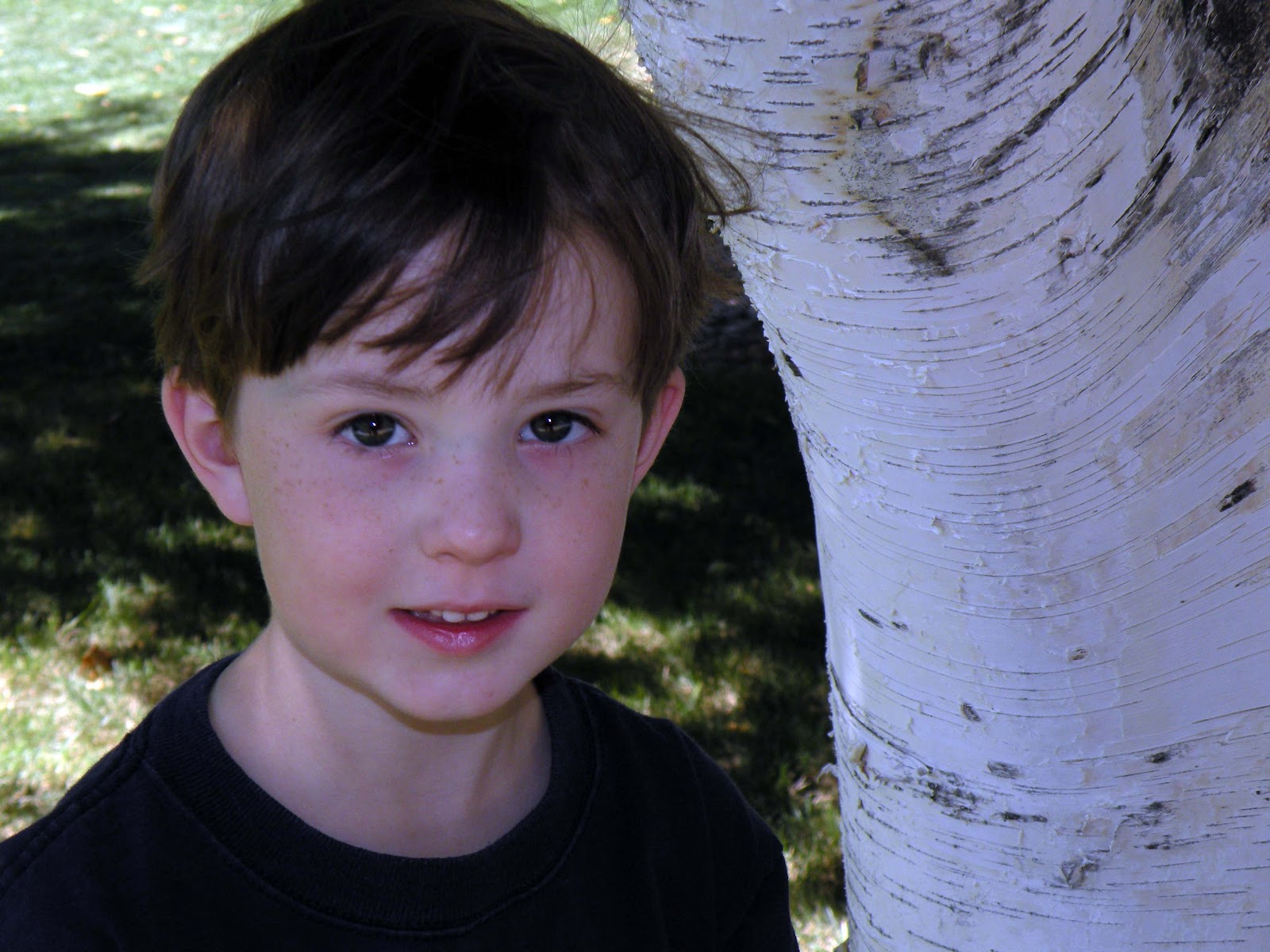
Noah
Monday, November 14, 2011
Accentuating the Positive

The lyrics of an upbeat Johnny Mercer tune from the 1940s advised us to "Accentuate the positive, eliminate the negative, and don't mess with Mr. In-between." Those lyrics came to mind last week when I asked a sixth grade friend of mine how school was going. "Great," he bubbled, "I didn't pull one ticket last week." That was good news, since, at his school, tickets are given for misbehavior and three tickets buy you a detention.
An hour later I was talking with my daughter.
"How are the kids doing in school?'
"Well, Noah got a 'tiger ticket'."
"Oh, no. What did he do?" (Noah is in kindergarten.)
"No, Dad. Tiger tickets are a reward for good behavior. There are three copies: one for the pupil, one for the teacher, and one goes to the principal. As they mount up, they give the student more chances to win prizes later in the year." Noah had solved a conflict with a classmate in a constructive way.
The juxtaposition of these two episodes on the same day from two different schools reminded me of my days teaching Psychology 101. There's solid research to support the idea that positive reinforcement in most instances works better than negative.
Last week was not a good week in this country for children. It seemed that every day brought another piece of national news that was devastating for a child or a group of children. It was easy to get angry and lash out and I started to do that. Then I remembered Libby's comment, "Noah got a 'tiger ticket'," and I decided then and there that I was going to do what Mercer had crooned about: Accentuate the positive. It doesn't have to mean sappy indifference to the disgraceful, sometimes felonious, attacks on children, but it does mean that I'm not going to forget that in the midst of this carnage, there are dedicated teachers giving tiger tickets for good behavior.

Sunday, November 6, 2011
Great Teachers Come in All Sizes
If you were to ask Noah today how old he is, he would answer you with convincing precision: "Six and a half." Ages ago, when he had just turned six, he did something that surprised even his mother, Libby, who happens to be my daughter.
One evening as he jumped onto his bed with a book in hand and his older sister, Madeleine, next to him, Libby sat down beside the two for their regular evening story. But this was to be no regular evening. Noah took the book back from his mother, proclaiming, "I'll read to you tonight." Libby humored him, remembering that he did recognize a few words, his own name among them, and that he could sound out a few others. Hardly enough to read the book in question. As Noah opened the book and began to read, first haltingly and then with more conviction, Libby sat stunned. Where had this come from? The answer came when Madeleine broke into a smile and finally began giggling.
Libby remembered that throughout the summer on the days when she was busy with laundry or house cleaning, the two siblings would entertain themselves, often playing school downstairs. But what she hadn't realized was that this was not merely play; this was serious stuff. Madeleine, two years older than her brother, had made herself the teacher with Noah her only and willing pupil.
Do you know some young teachers, either at home or in the classroom? I'm wondering what makes that teaching take so well.
P.S. Here's a note I got recently from Noah that apparently went out to a number of people via the internet:

Monday, October 31, 2011
A Hobo on Halloween

"Trick or Treat." Tonight on Halloween, the Eve of All Saints, children will dress up, not to look like saints, but to look like witches, goblins, fairies, and devils. Here in our neighborhood I'm looking forward to a goodly complement of Super Marios, Bart Simpsons, Pokemons, Darth Vaders, Barbies, princesses, soldiers, Tim Tebows, Obamas, and because we're in Laramie, Wyoming, surely a cowboy/cowgirl or two.
When I was their age (I know, I know. "You were never my age.") I always wanted to be a hobo. Why? Well, first of all, it was easy. It was during The War and like most of our neighbors, we didn't have much. Being a hobo was easy. I would just go down to the basement and grab a hunk of coal out of the coal bin. After blackening my face I'd get an old pair of overalls or dungarees - torn was best - and have Mother give me a swatch or two of cloth from the rag bag. I'd pin one on my knee and another on my seat and I was ready to go - almost. I had to get a stick from the woods behind the house and tie my red bandana to it, stuffed with old newspaper. One of Dad's old hats - crushed - would complete my authentic costume.
The other reason I liked being a hobo was the romance of it all. I could imagine hopping a boxcar and going wherever the train took me...no homework, no worries, no chores...just the fun of meeting other hobos along the way. Come to think of it, I still like that idea. Maybe tonight...
What did you like to be for Halloween? And why? Please comment below.

Monday, October 24, 2011

On Closing the Cottage
Fall's a fickle time of year
Not like summer, bold and clear,
Who keeps his promises as told
Not sometimes hot, then quickly cold.
And winter, too, will let you know,
"Get out your coat; it's going to snow
I won't warm up for quite a while
So dress to fight the frost in style."
With summer and winter, and even with spring
Your love affair is an honest thing,
But autumn's the time when you have to beware
Of a whore that can make your heart despair.
So Sonder's fort sits on the hill;
The fortress built with childhood skill,
Where he and Odin fought brave wars
With pines cone shells and aspen swords.
Abandoned ammo in a pile,
With swords they'll leave for a little while.
One autumn soon - ah, time will tell -
They'll leave their childhoods there as well.
And Larson's chin may still be wet
Where once s'mores were lapped by tongue
Between the laughs and giggles best
Appreciated by the young.
The fishing rods are in their rack.
"Don't worry, trout; I'm coming back;
I'll see you in the spring and then
We'll wage our contest once again."
The bags are packed, I've closed the pipes;
I've checked upon the space below
And boarded up the vents against
The winter winds and blowing snow.
I see her staring from the door
To where her humming birds would feed
And to the trees where jays would soar
For whom she'd kindly leave some seed.
Summer doesn't last, I know.
I sigh, "Sweetheart, it's time to go."

Subscribe to:
Posts (Atom)